Notification URLs (NURL and LURL) let InMobi Exchange inform DSPs of auction outcomes for each bid. They include a win notice with pricing details, or a loss notice with the reason code.
The following flowchart illustrates the lifecycle of a bid submitted to InMobi, from the initial InMobi auction through the downstream mediation auction. It shows the decision points that determine whether a bid progresses to mediation or is eliminated and indicates when Win Notification (NURL) and Loss Notification (LURL) callbacks are triggered. The flowchart also summarizes the values populated in each callback based on the auction outcome.
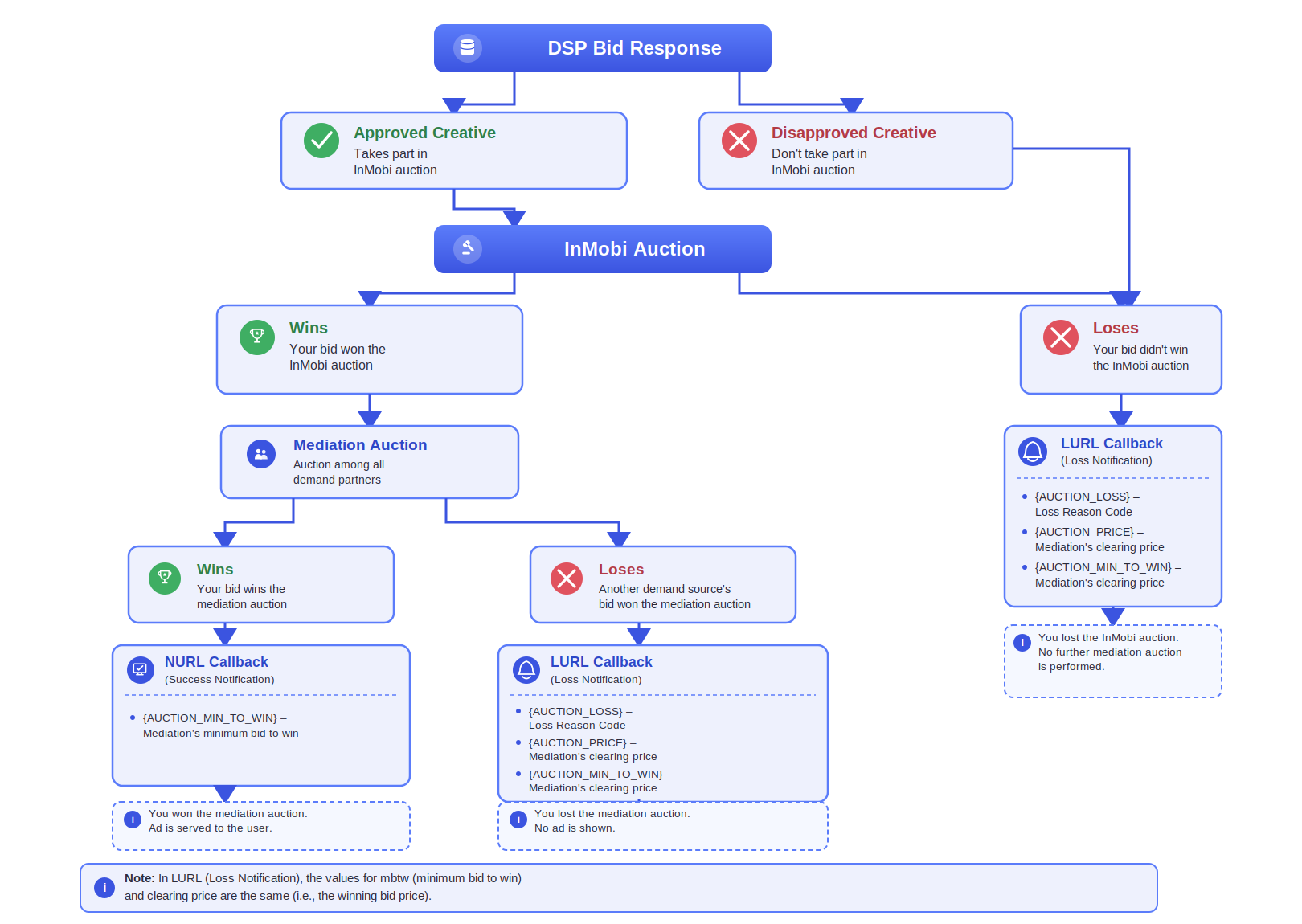
InMobi Exchange supports macro substitution aligned with the OpenRTB API Specification. These macros can be applied within the NURL and LURL during auctions. The table below outlines all macros currently supported by InMobi Exchange.
| Macro | Description | Supported URL (NURL/LURL) |
|---|---|---|
${AUCTION_ID} |
ID of the bid request from the BidRequest.id attribute. | Both NURL and LURL |
${AUCTION_BID_ID} |
ID of the bid; from the BidResponse.bidid attribute. |
|
${AUCTION_IMP_ID} |
ID of the impression just won, from the imp.id attribute. |
|
${AUCTION_SEAT_ID} |
ID of the bidder seat for whom the bid was made. | |
${AUCTION_AD_ID} |
ID of the ad markup the bidder wishes to serve; from the bid.adid attribute. |
|
${AUCTION_PRICE} |
Clearing price of the mediation auction, using the same currency and units as the bid. | |
${AUCTION_CURRENCY} |
The currency used in the bid (explicit or implied); for confirmation only. | |
${AUCTION_MIN_TO_WIN} |
|
|
${AUCTION_LOSS} |
Loss reason code indicating why a bid did NOT win the auction. See Loss Reason Codes for possible values. | LURL only |
These macros will be populated at 100% coverage when included in either the NURL or LURL.
For IP address handling of BURL, see InMobi BURL: IP and User-Agent Signals.
By installing this SDK update, you agree that your Children Privacy Compliance setting remains accurate or that you will update that setting, whenever there is a change in your app's audience. You may update the app's Children Privacy Compliance settings at https://publisher.inmobi.com/my-inventory/app-and-placements.
 Support Center


